Jesus Christ and Partial Differential Equations
A section from Appendix 1.13 in the book, "The Ass of the Apes"
4/14/20263 min read
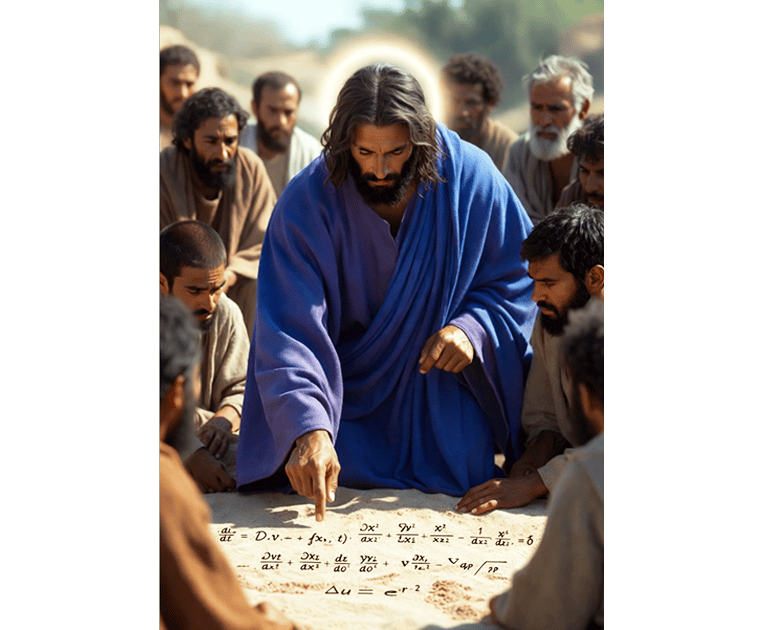

Jesus Christ and Partial Differential Equations
(A section from Appendix 1.13 in the book.)
This is a speculative-throughline, not dogma.
The proposal is simple: the same Christic event that linearized Western historical consciousness also helped to normalize a single, forward-running, homogeneous time parameter—the very thing early modern mathematics would later call t. Once “time” is no longer seasonal, cyclical, or purely dynastic, but a story with a hinge (Incarnation–Crucifixion–Resurrection) and an end (eschaton), it becomes thinkable as something you can count, divide, and write into equations.
The chain looks like this:
• Incarnational historicism: a once-for-all event sits at the center of time → time has direction.
• Ecclesial time-discipline: liturgical calendars, hours, and later mechanical clocks make time public, uniform, and shareable.
• Medieval voluntarism and natural philosophy: a contingent, law-governed creation must be measured to be known.
• Early modern mathematization: motion, fall, orbit, and flow get written as functions of a single variable.
• Calculus and, later, PDEs: once time is a smooth, universal parameter, you can describe systems that change together.
Stated rudely:
no Christ → no eschatological arrow; no arrow → no universal t; no universal t → no calculus; no calculus → no partial differential equations → no modern physics, no engineering, no real space program.
That is the provocation.
Of course, other civilizations came close. Alexandrian mathematicians had powerful geometric and limiting techniques; Chinese astronomers and Islamic algebraists achieved extraordinary precision. But their dominant temporal imaginaries were more cyclical, imperial, or pragmatic. What the Latin Christian West did was stack those older techniques on top of a culture that had already been living for centuries inside a one-direction, salvation-history timeline. That cultural comfort with a single, abstract, forward-running time made it natural—even obvious—to write the world as a function of t.
Read this, then, as a Hot-Philosophy footnote/gloss on the history of science: is the Incarnation—a divine seeding of linear time? And the calculus: its late mathematical aftershock? Are we humanized and uplifted via Christ's life, at least as presented in the New Testament—beyond all others—not only ethically—but practically? Scientifically—and technologically?
Is Jesus then: a kind of salvation?
It takes millennia, and the Jews in particular take it hard on the chin—Christianity is in effect born of anti-Semitism, and this played out in numberless acts of atrocity against Jews, of which the Holocaust was only apex and pinnacle. But from this shift comes not only Christianity, but also the conceptual scaffolding for science, human rights, women’s rights, the calculus, universal history, and even the very notion of progress. As Rodney Stark and others have argued, the metaphysical assumptions seeded by Christian monotheism—however corrupt its institutions—enabled the very conditions necessary for rational inquiry and technological emergence.
And so we find ourselves here: God dead—but his fingerprints still warm. Jesus fictional: concocted narratives around a Judean troublemaker, blending Platonic Logos notions not with Jewish resistance to Rome but with timely taxpaying and obeisance to the empire—substantially, nay massively concocted and fictional—but functionally disruptive over time—a proof-of-principle phenomenon.
Not literally true; only functionally true.
So: what if the God-idea was never real in itself—but seeded into us? A myth injected like a time-release capsule, to lift us one cognitive tier above the tribe, to plant the possibility of ethics not based in fear, or on regard only for one’s merely immediate local and fellow tribe members—but in a universalized love.
History is transformed. An awareness of the transformation marks the educated person. And at the transformation's pivot, stands this strange syncretic figure and amalgam.
Therefore, Jesus is just all right with me, as the American rock band the Doobie Brothers put it so well.
This is not a confession of faith. It is a recognition of anomaly. A conceptual gesture toward what might be called: divine seeding.
The Hot Philosophy: Love at the End of Time
Not only analysis: a growing movement, for a conceptual, ethical, educational and social revolution.
Radical: FROM THE LATIN 'RADIX,' ROOT
Get Emails from CJ Pulér — raw dispatches from the edge.
radix@thehotphilosophy.com
© 2025. All rights reserved.
The clock is ticking on the human race. Join the movement to rewrite and update our firmware---while we still have time.
The book and the sites are one fire. Enter either, and you enter the Hot Philosophy.
Terms of Use / Legal Stuff
privacy policy