Final Thoughts On That Old Greek Weirdo, Plato
Appendix 6.2 from the book "The Ass of the Apes."
4/14/20268 min read
My post content
Final Thoughts On That Old Greek Weirdo, Plato
(I'm posting Appendix 6.2 from the book here, as it will be linked to in a review I'm writing online.)
The safest general characterization of the European philosophical tradition is that it consists of a series of footnotes to Plato.—Alfred North Whitehead
Plato remains the fountainhead of Western philosophy, the dipole-element figure to whom every later thinker either bows or rebels. He gave us not only philosophy as a massive achievement and discipline, but the very mode of conceptual abstraction by which we imagine transcending time, body, and circumstance. And yet, from the start, he carried the seeds of our peril.
It is time: time to deconstruct the Grand Old Man himself, the fountainhead himself, that ur-footnote-generator: that old weirdo Plato—and by implication and intent: the tradition that is his footnote. But first, an appreciation of one of his glorious insights.
The Form of the Good
Human beings occupy a strange and unique ecological niche. Plato, and those who followed his tradition, suggested that something tugs at us—something upward, something axial.
It’s not silly. We’ve seen that creativity is embedded in matter and form. Plato called it the Good; others mention God. Whether it’s a pre-existing condition, or something emergent is beside the point, for our purposes here. Empathy—even for other species at times—emerges even amongst our primate cousins. Not only horror is real; good is real, too.
Despite the almost endless litany of human horrors, a current of creativity pulses through both the physical universe and human history. Reflection on this pattern of emergence gives rise to concepts like our Firepath. We may take heart in the fact that human beings possess not only our primitive, primate-core Ape modules—but also the capacity to imagine new hypotheses: about the cosmos, and about ourselves.
Following Plato, we propose that the mind can ascend—and indeed must, if it is not to stagnate—through what might be called the hypothesis of the higher hypothesis: 136 not merely replacing one belief with another, but replacing the entire axiomatic framework through which reality is conceived. This recursive ascent—through skein revision, meta-conceptual integration, and symbolic reorientation—is the core mechanism of conceptual evolution. It is how the mind escapes the cage of its own prior compression. It is abduction—hypothesis formation—now theorizing upon itself: upon the larger historical process at work—as mind and human power grow—and as the Inner Ape becomes companion and aspect of the self—rather than its commandeering Brute Ghoul.
The historical unfolding of mathematical and technical achievement—hinted at in other civilizations, but only fully realized in Western Europe—bears out Whitehead’s remark. But more than just historical process, this ascent allows the human mind to penetrate invisible domains: the vastness of deep space, the interior of the atom—and now, at last, the modular structures of the mind itself.
What new vistas await? Provided we don’t destroy ourselves of course.
Mathematics and the New Platonists
Many contemporary scientists and mathematicians—whether or not they call themselves Platonists—tacitly operate as if mathematical structures exist, independent of human minds. Numbers are not invented; they’re discovered. Prime distributions, tensor symmetries, the deep structure of equations—they are simply there, waiting to be uncovered. The physicist Roger Penrose, for instance, has argued that mathematics is not just a convenient tool or language we invented, but a discovery of truths that already exist in a “Platonic realm.” For Penrose, mathematical objects are timeless, nonphysical entities that human minds can access—a position deeply resonant with Plato’s theory of Forms.
This view is controversial but persistent. Modern set theory, category theory, and even debates over the foundations of logic—intuitionism versus classical formalism—often circle back to the same question: are mathematical entities “real” in some non-material sense? Is the infinite an invention, or a discovery? The mathematician Kurt Gödel, whose incompleteness theorems revolutionized 20th century logic, was a vocal Platonist, asserting that we perceive mathematical truths much as we perceive colors or shapes: not by construction, but by direct insight into an objective (though non-empirical) domain.
Even in theoretical computer science and cosmology, Platonic echoes remain. From Tegmark’s “Mathematical Universe Hypothesis” to Penrose’s noncomputable consciousness theory to quantum interpretations invoking Hilbert spaces of potentiality—the idea that reality just is mathematical order, or is guided by mathematical order, remains alive. The Hot Philosophy, too, affirms this: that beneath the ape-roar of hunger and lust lies a symbolic code structure—an intelligible lattice, written in the compressed fire-script of the real.
Our Code Engine diagram gives Plato his place of philosophical honor. At its top node—beyond modules of lust, shame, and authority—sits a speculative attractor: Plato’s Good / God / Telos? This is not dogma, but recognition that the human mind has always sensed something beyond chaos: a leaning toward order, truth, and symbolic ascent. The question mark is essential, but so is the node.
“God is running a program,” as I have sometimes said. Plato named it the Good. We name it an attractor embedded in evolution, symbol, and skein. As mind grows in awareness: freedom begins to emerge.
From freedom in the ape, to telos in the cosmos: that is our trajectory. With Plato we see the first glimpse of the attractor; with modern science we see its traces in mathematics and evolution; with the Hot Philosophy we try to place it honestly, in our Code Engine, and as a metaphysical reality.
Creativity and goodness are real. But there’s a dark side to Plato; his footnote is soiled.
Repression At the Core of Western Discourse
From the start, he carried the seeds of our peril.
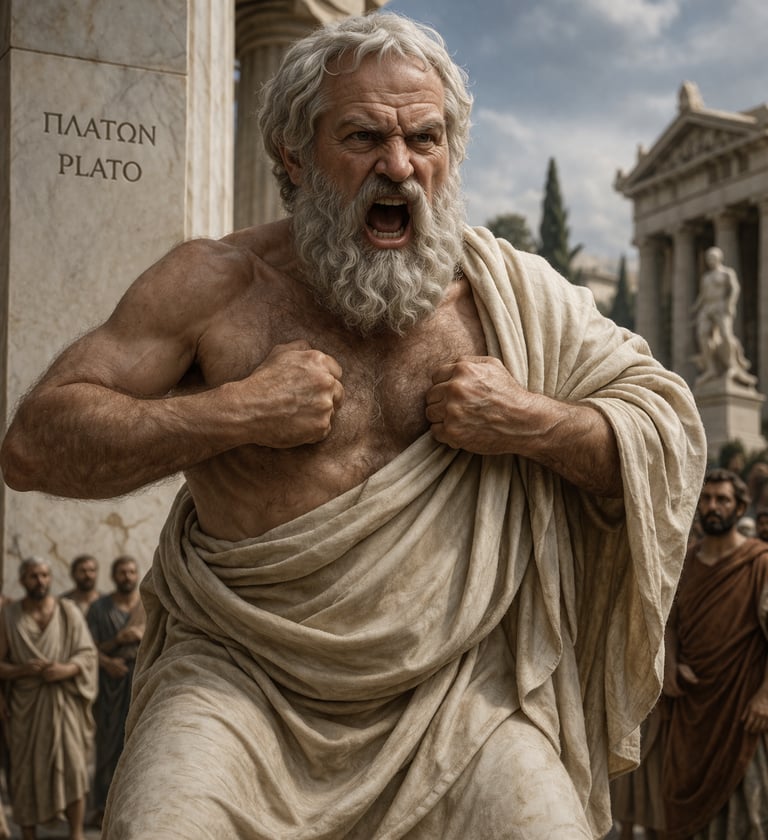
Despite his genius, Plato was no liberal. He was, in temperament, a hierarchical thinker: suspicious of democracy, disdainful of the mass, quick to propose a rigid order with philosopher-kings at the top and the poets banished. For him, truth required control, guardianship, and censorship. Poetry—unruly, bodily, emotional—was a threat; better to tame it. Better to tame all that is unpredictable, bodily, and chaotic.
This leads to his deeper mark on our history: Plato’s body-skepticism. In dialogue after dialogue—the Phaedo, the Republic, the Symposium—the body is cast as a prison or a distraction. Senses are unreliable, appetites base, sex a temptation to be climbed over on the “ladder of love.” Knowledge requires turning away from the flesh toward the immaterial Forms. The true philosopher lives, as far as possible: as if already dead.
Strains of Eastern thought sought also to restrain, even mortify the body to achieve purification, but Plato’s move here must surely be the original, signal and perhaps archetypal human intellectual move of repression. Western philosophy itself then literally begins with a mental gesture of contempt for the body. To know, one must deny; to transcend, one must suppress. And here lies the paradox: by denying the body, Plato unleashed the energy of abstraction that would power Western civilization, and its immense historical accomplishments. By repressing eros, he concentrated it into concept. Repression became the very engine of history.
You can see the trade-off. By sidelining the body, Plato and his heirs created the discipline necessary for literacy, law, mathematics, bureaucracy, and science. Christianity would inherit this dualism wholesale: Paul declares “to be carnally minded is death” (Romans 8:6), the Church Fathers treating flesh as sin, salvation as escape. The Word—Jesus as Logos—is the triumph of Christian Platonism over its Judaic roots and faction, the body translated into pure symbol, the man turned into doctrine; Spotless Mary follows as night follows day. Centuries later, Descartes would echo it: res cogitans versus res extensa, mind versus body: hard dualism, mind now conceptualized into a box essentially wholly and completely divorced from body and the world.
Homer Simpson as a Closet Platonist
Consider the joke of Homer Simpson in his philosopher-mode, from The Simpsons TV show:
What is mind? No matter. What is matter? Never mind.
A clever joke; but it in fact situates Western philosophy perfectly: ultimately culminating in the impossible absurd paradox of the hard dualism of Descartes, and Homer; a metaphysic better discarded now and shunted aside. Philosophy as a whole has carried forward this primal repression from Plato—the essential impossibility and absurdity of the enterprise notwithstanding.
Via mathematics and reflection, and the skein of science, mind can access dimensions invisible to the naked eye: primate brain modules, carbon chains and nucleic acids, distant galaxies and the sub-atomic realm, the metrics of gravitational fields; and perhaps more. Separating mind from body can be a useful heuristic exercise, to perhaps develop new perspectives. But taken literally rather than as analytical metaphor, it has disastrous long-run effects.
On the Agelong Legacy and Consequences of Plato's Repression, and a Call to Redefine the Good as Integration
We have seen that western philosophy thus sometimes culminates in scholastic games, or fatuous silliness—or something far worse. Recursions upon category errors become legitimations to hate, murder, imperial conquest, and even harm directed at children or other vulnerable people; the Ape rationalizes up his darkness—into new premises for primate possession and ego-aggrandizement.
But it worked, for a while. Repression was historically effective. It gave us two millennia of conceptual horsepower: rational law, democratic forms, technological revolutions, the expansion of liberty itself. But the cost was immense: alienation, neurosis, a civilization trained to either hate its own flesh or grant it only a grudging necessity. Western man became the animal who mistrusted his hungers, who could only think clearly by effectively despising his body. Immensities of confusion, suffering, hate, antisemitism, misogyny, and novel constructions of violence ensued.
The Hot Philosophy insists we must now recognize this trade-off for what it was: a historical necessity, but not a permanent destiny. Plato’s great gift—his intuition of the Form of the Good—was his glimpse of a telos, an attractor, a sense that reality itself leans toward order and coherence. Contemporary mathematicians agree that the world ultimately includes number at its foundation. Mind can and does ascend, from the Brute Ape, through a succession of higher hypotheses, toward the Good: what we call a continuing recursion of compressions. Plato and the West glimpsed, and took, the initial path, in perhaps the only way possible at the time; no vocabulary existed as yet for a Hot Philosophy. We might say the Good tugged us, moving within history, at its slow and glacial pace, as it could; perhaps God has Time, as William Cavanaugh put it.
We have seen, and shall recap again here in this Appendix, that creativity is embedded in matter and form.
We are thus indebted to Plato, and the entire Western discourse that follows from his genius. But his great mistake was to insist that the only way to reach the Good was through repression. The Good was glimpsed, but at the cost of flesh denied.
What if the next step is the opposite? What if the Good is not reached by turning away from eros—but by facing it? What if philosophy must finally risk what Plato feared most: poetry, body, shame, the whole ambivalent animal? If Whitehead was right that all of philosophy is footnotes to Plato, then perhaps the final footnote is this: that his repression has run its course, that the energy it yielded has been spent, and that the future depends on reconciliation, not denial.
Plato is thus both the archetype and the warning. Philosophy itself is perilous because it tends toward repression—toward order bought at the expense of life. The Hot Philosophy proposes the inversion: order through integration, not suppression. The body is not the enemy of truth; the body is the ground of truth.
And so we leave Plato—grateful for his gift, wary of his shadow. He remains the weirdo who named the Good, but also the man who condemned the flesh. His philosophy set the pattern of our civilization: repression as fuel. Ours must set another: honesty as fuel, eros as fire: philosophy reconciled to the ape, with the Form of the Good at the top of mind—right alongside our fundament: at the bottom.
The Hot Philosophy: Love at the End of Time
Not only analysis: a growing movement, for a conceptual, ethical, educational and social revolution.
Radical: FROM THE LATIN 'RADIX,' ROOT
Get Emails from CJ Pulér — raw dispatches from the edge.
radix@thehotphilosophy.com
© 2025. All rights reserved.
The clock is ticking on the human race. Join the movement to rewrite and update our firmware---while we still have time.
The book and the sites are one fire. Enter either, and you enter the Hot Philosophy.
Terms of Use / Legal Stuff
privacy policy